5
For generations, bingo was viewed through a relatively narrow lens, often associated with smoky community halls, ink daubers, and a leisurely Friday night out. Today, that perception has been entirely rewritten. The digitization of the gaming industry and the creative revitalization of physical social spaces have transformed bingo into a highly dynamic, globally accessible entertainment option.
While the fundamental mechanic of matching called numbers to a printed or digital card remains the same, the framework surrounding that mechanic has fragmented into dozens of distinct variations. These different formats dictate the speed of the game, the strategies employed by the players, the social atmosphere, and the ultimate thrill of the win. Understanding the nuances of these game types reveals exactly why this classic game has managed to survive and thrive in a hyper-competitive entertainment landscape.
75-Ball Bingo: The American Classic and the Power of Patterns
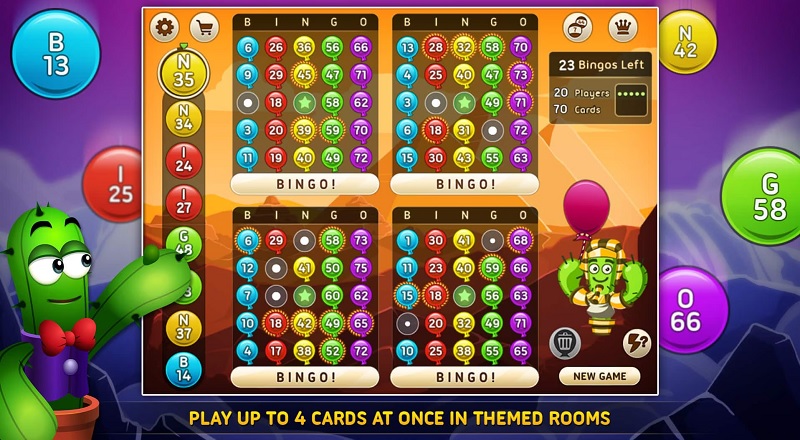
When most players in the United States picture a bingo card, they are envisioning the traditional 75-ball format. This variation is played on a square 5×5 grid containing twenty-four numbered spaces and a single “Free Space” anchored squarely in the middle. The columns are famously labeled with the letters B-I-N-G-O, with the numbers 1 through 75 distributed sequentially across them.
The defining characteristic of 75-ball bingo is its heavy reliance on pattern recognition. Unlike other variants where the goal is simply to complete a line, 75-ball allows organizers to get incredibly creative. Players might be tasked with daubing a diagonal line, the four corners of the card, a postage stamp shape in one corner, or complex shapes like a kite, a diamond, or specific alphabetical letters.
This reliance on patterns fundamentally changes the psychological experience of the game. It requires a higher level of active concentration. Players are not just scanning for numbers; they are constantly evaluating how close they are to completing an abstract shape. The tension builds differently here because a player might have heavily daubed their card but remain completely out of the running if those marks do not align with the required pattern. The ultimate format of this game is the coverall or blackout, where every single square must be marked to claim the grand prize, a feat that usually serves as the high-stakes finale to a session.
90-Ball Bingo: The European Standard and the Three-Act Structure
Across the Atlantic, 90-ball bingo reigns supreme in the United Kingdom, parts of Europe, and Australia. If 75-ball is a game of shifting patterns, 90-ball is a game of escalating tension driven by a rigid, traditional structure.
The physical layout of a 90-ball ticket is entirely different from its American counterpart. It features three horizontal rows and nine vertical columns. However, not every space contains a number. Each row features exactly five numbers and four blank spaces, meaning a single ticket holds fifteen numbers in total. The numbers range from 1 to 90 and are organized strictly by column, with the first column holding numbers 1 through 9, the second column 10 through 19, and so forth.
What makes 90-ball bingo such a compelling player experience is its built-in three-act payout structure. A single game offers three distinct opportunities to win. The first prize goes to the player who completes a single horizontal line. The game then immediately continues, with players racing to be the first to complete two horizontal lines on the same ticket. Finally, the round culminates in the race for the full house, which requires a player to mark off all fifteen numbers on their ticket.
This tiered system creates a phenomenal sense of pacing. Because there are three winners in every round, the game feels more rewarding and community-oriented. A player who misses out on the first line still feels fully engaged and optimistic about catching the second line or the full house. This sustained momentum is the primary reason 90-ball remains a staple in massive online bingo communities.
80-Ball Bingo: The Strategic Middle Ground
Born out of the need for a faster-paced physical game, 80-ball bingo was originally designed for specialized bingo clubs utilizing physical shutter boards rather than disposable paper cards. Today, it has found a massive second life in the online arena, serving as the perfect middle ground between the traditional American and European formats.
The game is played on a compact 4×4 grid, resulting in sixteen numbers per card. There is no free space. To aid in visual recognition, the columns are traditionally color-coded: red for the first column (1-20), yellow for the second (21-40), blue for the third (41-60), and silver or white for the fourth (61-80).
The 80-ball format incorporates the best elements of its predecessors. It utilizes the creative pattern-winning conditions of 75-ball, allowing for diagonal, vertical, and horizontal line wins, as well as four corners and custom shapes. However, because the grid is smaller and there are fewer total balls in the hopper, the gameplay moves at a notably brisker pace. This creates an energetic, highly fluid playing experience that appeals directly to modern players who want the strategic variety of pattern bingo without the lengthy time commitment of a 75-ball coverall game.
30-Ball Bingo: High-Octane Speed for the Digital Age
As mobile gaming has come to dominate the digital entertainment sector, player preferences have heavily shifted toward micro-gaming—experiences that can be enjoyed in short, intense bursts during a commute or a coffee break. Enter 30-ball bingo, frequently marketed as speed bingo.
This is the most aggressive, fast-paced variant available today. The card is stripped down to a minimalist 3×3 grid containing just nine numbers. The rules are entirely unambiguous: there are no lines, no shapes, and no tiered prizes. The only way to win a round of 30-ball bingo is to achieve a full house by marking all nine numbers.
Because there are only thirty balls in play, rounds are completed in a matter of minutes. The rapid-fire nature of the calls requires intense focus, making it a highly adrenaline-fueled experience. Speed bingo eliminates the slow burn of traditional formats, replacing it with instant gratification. It is a pure, unadulterated distillation of the bingo mechanic, perfectly optimized for the modern attention span.
Specialty and Hybrid Formats: Pushing the Boundaries
Beyond the numerical variations, the bingo industry has seen a massive surge in specialty formats that blend traditional mechanics with other forms of entertainment. These hybrid games are designed to attract demographics that might not engage with standard bingo, offering entirely unique atmospheres.
Music bingo has become a massive phenomenon in the hospitality industry, replacing numbered balls with short audio clips of popular songs. Players must identify the track and daub the corresponding song title on their card. This transforms an individualized game of chance into a highly social, collaborative trivia experience that thrives in bars and event spaces.
In the digital realm, developers have successfully merged bingo with slot machine mechanics to create hybrid games like Slingo. Players spin a reel to generate numbers that they then cross off a bingo grid, unlocking bonus features, multipliers, and mini-games along the way. This fusion introduces an element of player agency and resource management, as players often have to choose which squares to mark or when to purchase extra spins, elevating the experience from pure chance to light strategy.
Ultimately, the survival and continuous growth of bingo rely entirely on this incredible adaptability. Whether a player is seeking the communal, slow-building tension of a 90-ball full house, the visual puzzle of a 75-ball pattern, or the lightning-fast resolution of a 30-ball sprint, the underlying mechanics have been masterfully tailored to fit the exact experience they desire.
